Spiced sheet-pan focaccia
Berbere & Caramelized Onion Focaccia (Ethiopian-Inspired)
Warm, smoky Ethiopian berbere bloomed in olive oil over jammy caramelized onions — chili heat, fenugreek and cardamom on a tall, airy focaccia.
- Total
- 4.6 hr
- Hands-on
- 45 min
- Hydration
- 80%
- Skill
- intermediate
By FocacciaRecipe editorial · Updated 2026-07-05 · In editorial development; independent bake-test pending
The short version
Bloom 1–1.5 tablespoons of berbere in warm olive oil, brush it over a dimpled 80% hydration focaccia, top with slow-caramelized onions, and bake at 230°C/450°F for 20–24 minutes.
Why this works
Berbere is spice-dense and can turn acrid at high heat, so blooming it in oil first tames the raw edge and carries the aroma into the crumb; the sweetness of onions cooked down for 30+ minutes counterbalances the chili; 80% hydration gives a light interior that soaks up the spiced oil.
The schedule
~55m hands-on of 4.5h total · same day
- Mix & fold · 55m
- Bulk ferment · 2h
- Proof · 1h
- Bake · 22m
- Cool · 15m
Terracotta is active work; olive is unattended rising; red is the bake.
Ingredients
Method
- 1
Mix the dough
Whisk flour and yeast. Add water and 40 g olive oil, then the salt. Mix to a shaggy, very sticky dough with no dry flour left.
Look for: The dough should look wet and sticky and pull off the bowl in strands.
- 2
Bulk ferment with folds
Do 3 sets of stretch-and-folds over the first 90 minutes, then let rise until doubled and bubbly.
Look for: The surface should be domed and dotted with bubbles; the dough jiggles when the bowl is shaken.
- 3
Caramelize the onions
While the dough ferments, cook the sliced onions in 20 g oil with a pinch of salt over medium-low heat, stirring often, until deep gold and jammy, 30–40 minutes. Cool.
Look for: The onions should collapse to about a quarter of their volume and turn amber, not brown-black.
Avoid: Keep the heat low — rushed onions scorch bitter and undo the balance with the chili.
- 4
Bloom the berbere
Warm 40 g olive oil gently, stir in the berbere off direct high heat, and let it sizzle just until fragrant, about 30–60 seconds. Set aside.
Look for: The oil turns brick-red and smells of chili, fenugreek and cardamom — pull it before it smells sharp or burnt.
Avoid: Berbere scorches fast; bloom it off the heat in warm (not smoking) oil.
- 5
Pan and proof
Oil the sheet pan well. Stretch the dough to the edges, resting it if it fights back. Proof until puffy, about 1 hour.
Look for: The dough should relax to fill the pan and spring back slowly when pressed.
- 6
Dimple, oil and top
Dimple the dough all over with oiled fingers. Brush most of the berbere oil into the dimples, scatter the caramelized onions evenly, and drizzle any remaining spiced oil.
Look for: Red oil should pool in the dimples; onions sit on top, not buried in wet dough.
- 7
Bake
Bake at 230°C/450°F for 20–24 minutes until the edges are deep gold and the base is crisp.
Look for: The crust should be burnished red-gold and lift cleanly from the pan; the underside firm and browned.
- 8
After baking
Cool on a rack a few minutes, sprinkle with flaky salt, and scatter chopped cilantro over the top before slicing.
Look for: Fresh cilantro should stay bright green — it is added off the heat so it does not wilt to nothing.
What good looks like
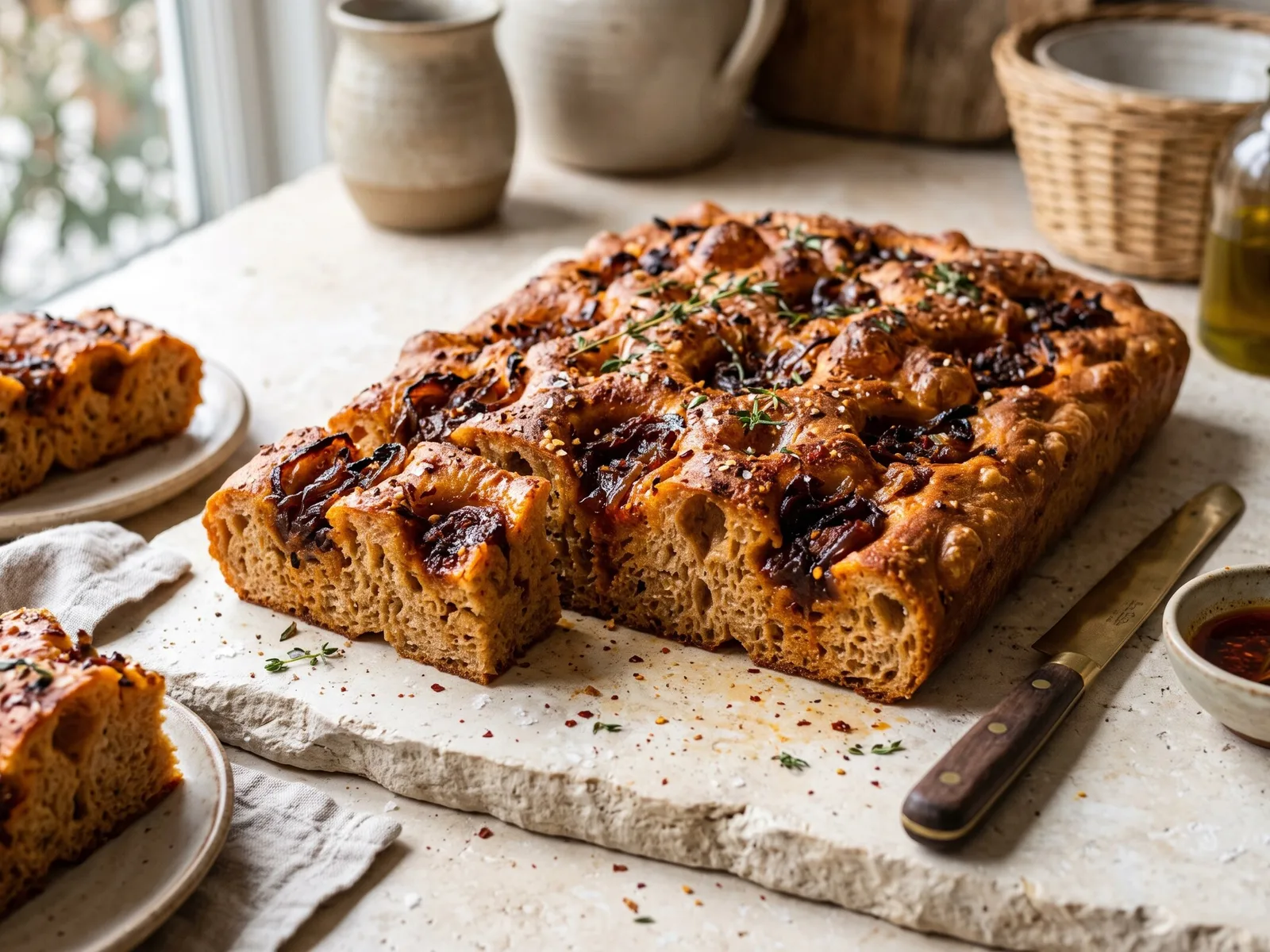
- Crumb: Open and airy, stained faintly red-gold from the spiced oil.
- Crust: Crisp oil-fried base with a burnished, chili-red top.
- Height: About 3 cm tall.
- Color: Deep amber edges; onions caramel-brown.
If something went wrong
| Symptom | Likely cause | Fix |
|---|---|---|
| Bitter, acrid spice | Berbere added dry and scorched at high oven heat | Always bloom berbere in warm oil first and keep it off direct high heat. |
| Harsh, unbalanced heat | Onions not caramelized enough to sweeten | Cook onions low and slow until genuinely jammy and amber before topping. |
| Soggy top | Onions added while still wet | Let the onions cool and dry slightly so they do not weep onto the dough. |
Storing & reheating
Storage: Best the day it is baked. Store cooled in an airtight container up to 2 days.
Freezing: Freeze cooled pieces wrapped up to 1 month.
Reheating: Re-crisp in a 200°C/400°F oven for 5–7 minutes; the microwave softens the base.
Contains wheat/gluten. Naturally dairy-free as written.
Tools & ingredients for this focaccia
Some links are affiliate links; as an Amazon Associate we may earn from qualifying purchases at no extra cost to you.
Core pantry
- Bread flour (opens Amazon) ↗ — High-protein bread flour or Italian “00” both work.
- Fine sea salt (opens Amazon) ↗ — Fine sea salt for the dough.
- Instant yeast (opens Amazon) ↗ — Instant (or active dry) yeast keeps for months.
- Extra-virgin olive oil (opens Amazon) ↗ — Use a good EVOO you like the taste of.
- Flaky finishing salt (opens Amazon) ↗ — For the crunchy finish.
Specialty ingredients
- Berbere (opens Amazon) ↗ — Ethiopian spice blend.
Fresh — buy local
- Onions (opens Amazon) ↗ — A kitchen staple; buy fresh.
- Fresh herbs (opens Amazon) ↗ — Fresh is best; a windowsill pot works well.
You don’t need to buy everything here — many items are already in most kitchens. Fresh produce, cheese and herbs are best bought local and in season.
Frequently asked
- Is this an Ethiopian bread?
- No — it is an Italian focaccia seasoned with Ethiopian berbere. Traditional Ethiopian breads like injera are made from teff and fermented very differently; this borrows the spice tradition, not the bread.
- How spicy is berbere?
- It varies a lot by brand. Taste yours first and start with 1 tablespoon if it is fiery; you can always brush on more spiced oil.
Keep baking
In these collections
Source: https://www.focacciarecipe.com/recipes/berbere-caramelized-onion-focaccia · © 2026 FocacciaRecipe.com
In editorial development — this recipe has not yet completed physical bake-testing.