Classic pan focaccia
Classic Italian Focaccia
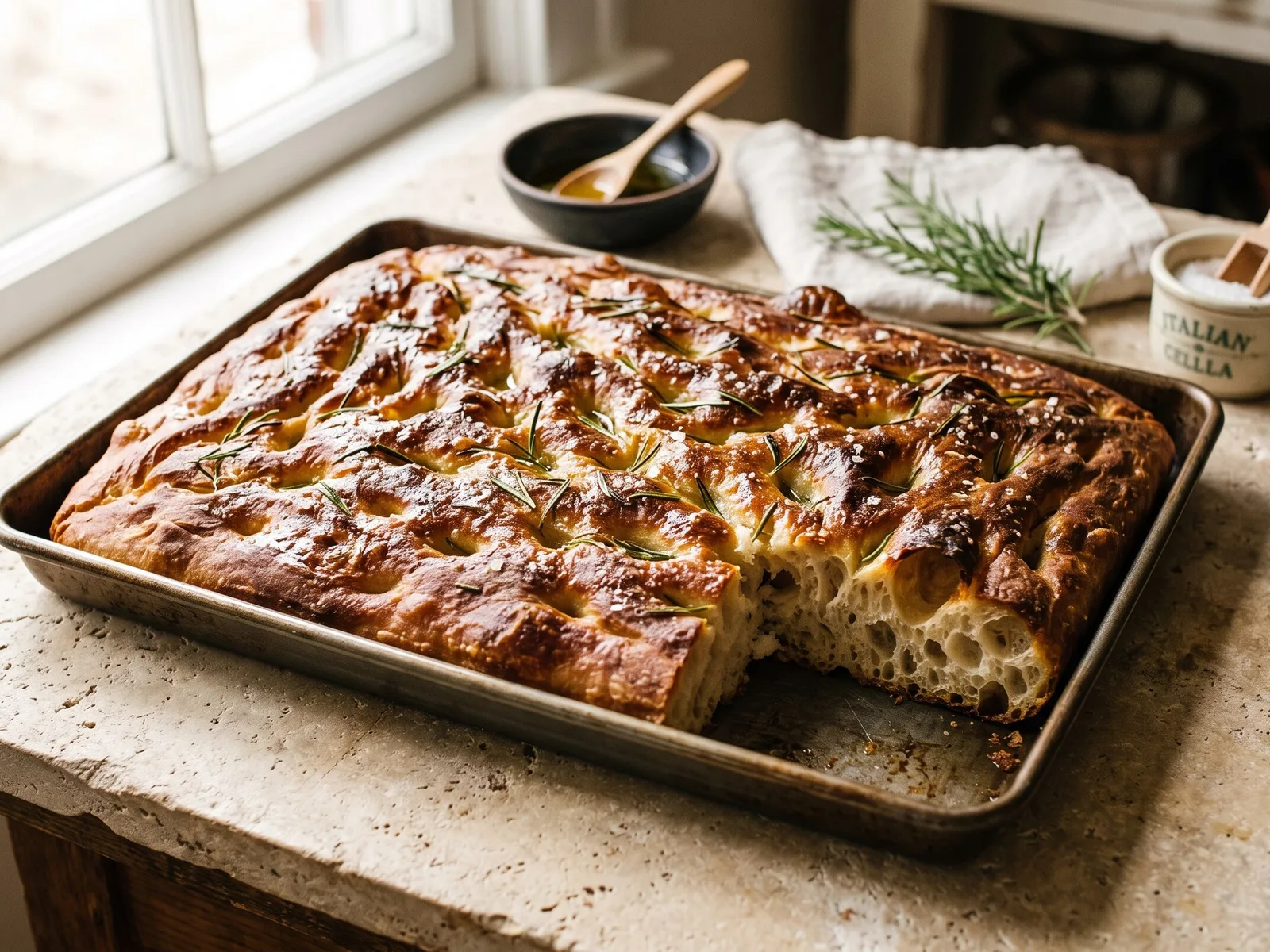
A tall, olive-oil-rich focaccia with a crisp base and an open, tender crumb — the reference recipe everything else on this site builds from.
- Total
- 15 hr
- Hands-on
- 25 min
- Hydration
- 80%
- Skill
- beginner
By FocacciaRecipe editorial · Updated 2026-07-05 · In editorial development; independent bake-test pending
The short version
For one 33×23 cm pan, mix 500 g bread flour, 400 g water (80% hydration), 10 g salt, 4 g instant yeast and 40 g olive oil; fold three times over two hours, cold-proof overnight, then dimple, brine, and bake at 230°C/450°F for 20–25 minutes.
Why this works
High hydration gives the open, custardy crumb; a long cold ferment builds flavor and makes a wet dough easy to handle; a generous layer of olive oil under and over the dough fries the base to a crisp shell while steaming the top soft.
The schedule
~40m hands-on of 15.4h total · overnight
- Mix & fold · 40m
- Bulk ferment · 2h
- Proof · 12h
- Bake · 23m
- Cool · 20m
Terracotta is active work; olive is unattended rising; red is the bake.
Ingredients
Method
- 1
Mix
Whisk flour and instant yeast in a large bowl. Add the water and 20 g olive oil, then the salt, and mix with a wet hand or dough whisk until no dry flour remains.
Look for: The dough will be shaggy, sticky, and rough — that is correct. Do not add flour.
- 2
Fold (three times)
Over the next two hours, do three sets of stretch-and-folds spaced ~30 minutes apart: wet your hand, grab one side, stretch it up and fold it over the middle; rotate and repeat four times.
Look for: By the third fold the dough should feel smoother, stronger, and hold a loose ball.
- 3
Cold proof overnight
Cover the bowl and refrigerate 12–24 hours. This slow, cold fermentation is where most of the flavor develops.
Look for: The dough should roughly double and be dotted with bubbles.
- 4
Pan and rest
Coat a 33×23 cm pan with 15 g olive oil. Tip the dough in, turn to coat, and gently stretch toward the corners. If it resists, rest 15 minutes and try again. Let it come up at room temperature until puffy, 1–2 hours.
Look for: The dough should relax to fill the pan and look pillowy and alive before baking.
Avoid: Do not force a cold, tight dough into the corners — you will tear the gluten and lose the open crumb.
- 5
Dimple and brine
Whisk the brine (20 g water + 10 g oil). Oil your fingers and press straight down to the pan bottom all over the dough, then pour the brine into the dimples. Add flaky salt and rosemary.
Look for: The surface should look like a dimpled pool — the brine sitting in the wells is what gives the signature texture.
- 6
Bake
Bake in a preheated 230°C/450°F oven for 20–25 minutes, until the top is deep golden and the edges are crisp.
Look for: Look for a uniform deep-gold top and audibly crisp edges; the base should be firm when you lift a corner.
- 7
Cool
Lift the focaccia out of the pan onto a rack within a few minutes so the base stays crisp. Cool at least 20 minutes before cutting.
Look for: Cooling on a rack keeps the bottom from steaming soft.
What good looks like
- Crumb: Open and tender with irregular holes, slightly custardy near the base.
- Crust: Crisp, olive-oil-fried bottom; soft, golden, dimpled top.
- Height: About 3–4 cm tall in a 33×23 cm pan.
- Color: Deep, even gold — not pale. Under-baking is the most common miss.
If something went wrong
| Symptom | Likely cause | Fix |
|---|---|---|
| Dense, tight crumb | Dough over-worked into the corners while cold, or under-proofed | Let the panned dough warm and relax fully until pillowy before dimpling. |
| Pale, soft base | Too little oil in the pan or oven not hot enough | Use enough oil to coat the pan and preheat fully to 230°C/450°F. |
| Gummy interior | Under-baked | Bake to deep gold and ~96°C internal; give it a few extra minutes. |
Storing & reheating
Storage: Best the day it is baked. Store cut-side down in a paper bag at room temperature up to 2 days.
Freezing: Freeze cooled pieces in a sealed bag up to 1 month.
Reheating: Refresh in a 200°C/400°F oven for 4–5 minutes to re-crisp; avoid the microwave.
Contains wheat/gluten. Recipe is dairy-free and vegan as written.
Tools & ingredients for this focaccia
Some links are affiliate links; as an Amazon Associate we may earn from qualifying purchases at no extra cost to you.
Core pantry
- Bread flour (opens Amazon) ↗ — High-protein bread flour or Italian “00” both work.
- Fine sea salt (opens Amazon) ↗ — Fine sea salt for the dough.
- Instant yeast (opens Amazon) ↗ — Instant (or active dry) yeast keeps for months.
- Extra-virgin olive oil (opens Amazon) ↗ — Use a good EVOO you like the taste of.
- Flaky finishing salt (opens Amazon) ↗ — For the crunchy finish.
Required pan & tools
- Light-colored metal baking pan, 33×23 cm (9×13 in) (opens Amazon) ↗ — A light or anodized aluminum pan browns the base evenly; very dark pans can over-brown the bottom before the top is done.
- Digital kitchen scale (0.1 g resolution) (opens Amazon) ↗ — Focaccia is a set of ratios; a scale is the single biggest upgrade to consistency. Fine resolution matters for small salt and yeast weights.
- Instant-read thermometer (opens Amazon) ↗ — Under-baking is the most common cause of a gummy focaccia; a thermometer removes the guesswork (~96°C finished).
- Stainless bench scraper (opens Amazon) ↗ — Handles and portions sticky, high-hydration dough without adding flour.
Fresh — buy local
- Fresh herbs (opens Amazon) ↗ — Fresh is best; a windowsill pot works well.
You don’t need to buy everything here — many items are already in most kitchens. Fresh produce, cheese and herbs are best bought local and in season.
Frequently asked
- Can I make this same-day?
- Yes — proof warm (~2–3 hours) instead of overnight, but the flavor is noticeably better with the cold ferment.
- What hydration is this?
- 80% — 400 g water to 500 g flour. Try our Hydration Calculator to adjust it.
- Do I need bread flour?
- It gives a chewier, more open crumb, but all-purpose works.
Keep baking
In these collections
Source: https://www.focacciarecipe.com/recipes/classic-focaccia · © 2026 FocacciaRecipe.com
Editorial development version — quantities follow standard focaccia practice but has not yet completed physical bake-testing.