Lean thin olive-oil flatbread (focaccia cousin)
Schiacciata Toscana (Tuscan Olive-Oil Flatbread)
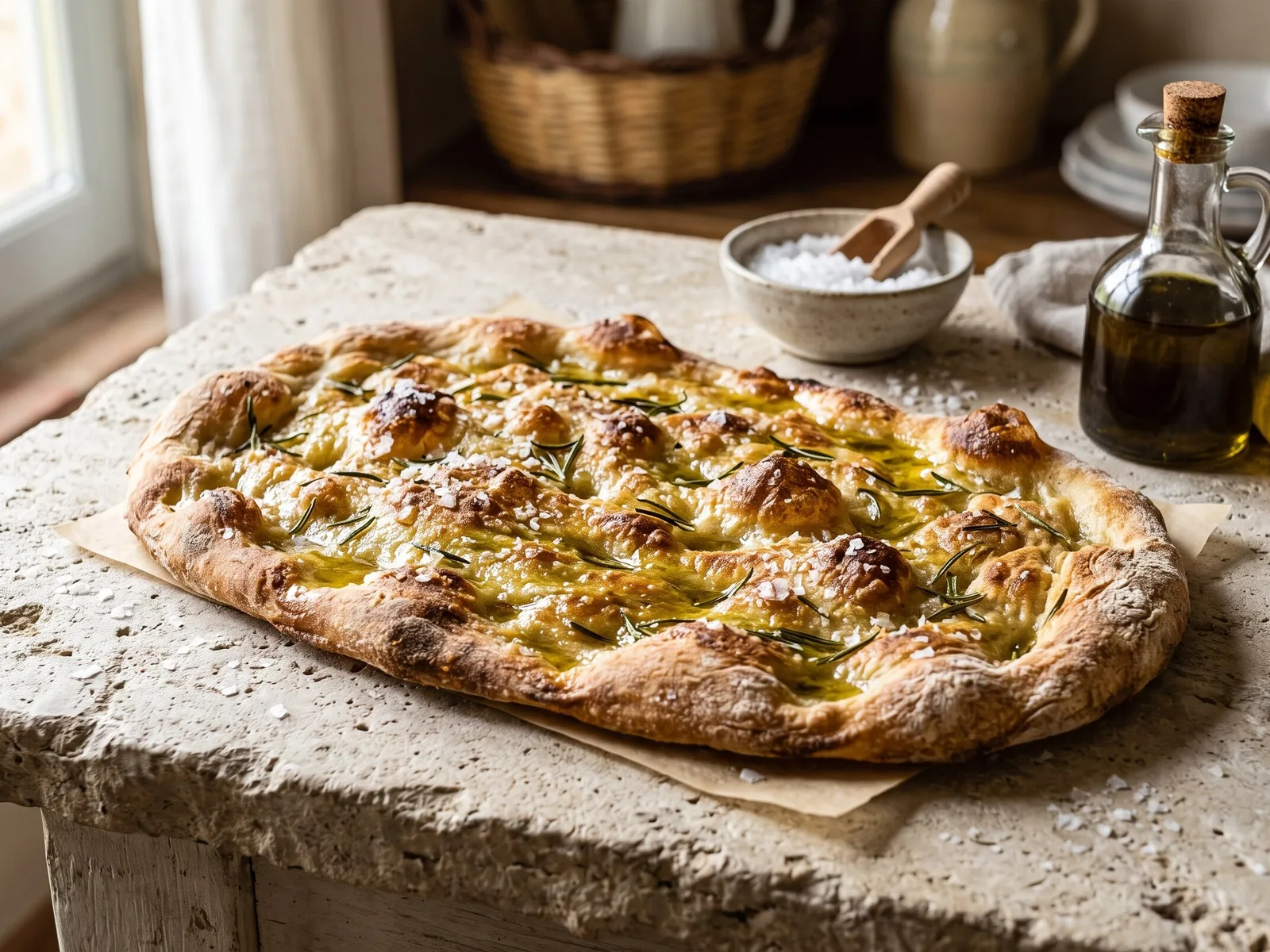
Tuscany’s lean, crisp flatbread: thinner and lighter than focaccia, blistered gold and brushed with fragrant new olive oil and crunchy coarse salt the moment it leaves the oven.
- Total
- 3.1 hr
- Hands-on
- 20 min
- Hydration
- 64%
- Skill
- beginner
By FocacciaRecipe editorial · Updated 2026-07-05 · In editorial development; independent bake-test pending
The short version
Make a lean ~64% hydration dough (500 g flour, 320 g water, 20 g oil, 9 g salt, 5 g yeast), press it thin into a 30×40 cm pan, dimple, bake at 220°C/430°F for about 18 minutes, then brush the warm surface with good olive oil and scatter coarse salt.
Why this works
Less oil in the dough and a thinner sheet give a crisper, lighter bread than focaccia; the defining flavour comes from oil brushed on after baking, where it isn’t cooked and keeps its raw, peppery fragrance; coarse salt on top adds seasoning and crunch without dissolving in.
The schedule
~30m hands-on of 3.2h total · same day
- Mix & fold · 30m
- Bulk ferment · 1.5h
- Proof · 45m
- Bake · 18m
- Cool · 10m
Terracotta is active work; olive is unattended rising; red is the bake.
Ingredients
Method
- 1
Mix
Whisk flour and yeast, add water and the small amount of oil, then salt. Mix to a soft but not very wet dough.
Look for: Smooth and slightly tacky, firmer than a high-hydration focaccia.
- 2
Bulk ferment
Cover and rise until nearly doubled.
Look for: Puffy and airy, close to doubled.
- 3
Roll thin and pan
Oil the pan lightly and press or roll the dough out thin and even to the edges — thinner than focaccia.
Look for: A low, even sheet; it should look distinctly flatter than a focaccia in the pan.
- 4
Short proof and dimple
Let it relax and puff briefly, then dimple lightly.
Look for: Just risen, with shallow dimples — not the deep pools of focaccia.
- 5
Bake
Bake at 220°C/430°F until pale gold and crisp.
Look for: Light gold, blistered in spots, crisp at the edges.
- 6
Finish with raw oil and salt
While still warm, brush generously with your best extra-virgin olive oil and scatter coarse salt.
Look for: The warm surface drinks the oil and turns glossy; salt crystals stay crunchy on top.
What good looks like
- Crumb: Light and fairly fine — crisper and less pillowy than focaccia.
- Crust: Thin and crisp, glossy with finishing oil.
- Height: Low and thin — noticeably flatter than focaccia.
- Color: Pale to light gold.
If something went wrong
| Symptom | Likely cause | Fix |
|---|---|---|
| Heavy, bready result | Rolled too thick or over-proofed | Press it thinner and keep the final proof short. |
| Flat, dull flavour | All the oil baked in, none added after | Reserve good oil to brush on the warm bread — that raw finish is the point. |
| Salt dissolved away | Fine salt used to finish | Finish with coarse or flaky salt so it stays crunchy on top. |
Storing & reheating
Storage: Best the day it’s baked; keep loosely covered up to 1 day.
Freezing: Freeze cooled pieces up to 1 month; refresh in a hot oven.
Reheating: Warm in a 200°C/400°F oven 3–4 minutes to re-crisp.
Contains wheat/gluten. Naturally dairy- and egg-free.
Tools & ingredients for this focaccia
Some links are affiliate links; as an Amazon Associate we may earn from qualifying purchases at no extra cost to you.
Core pantry
- Bread flour (opens Amazon) ↗ — High-protein bread flour or Italian “00” both work.
- Extra-virgin olive oil (opens Amazon) ↗ — Use a good EVOO you like the taste of.
- Fine sea salt (opens Amazon) ↗ — Fine sea salt for the dough.
- Instant yeast (opens Amazon) ↗ — Instant (or active dry) yeast keeps for months.
You don’t need to buy everything here — many items are already in most kitchens. Fresh produce, cheese and herbs are best bought local and in season.
Frequently asked
- Is schiacciata the same as focaccia?
- They’re close relatives but not the same: Tuscan schiacciata all’olio is thinner, leaner and crisper, and gets its character from olive oil brushed on after baking rather than heavy oil in and on the dough.
- Why brush the oil on after baking?
- Baked oil loses its fresh, peppery aroma; brushing good raw oil on the warm bread keeps that fragrance and gives schiacciata its distinctive finish.
Keep baking
In these collections
Source: https://www.focacciarecipe.com/recipes/schiacciata-toscana · © 2026 FocacciaRecipe.com
In editorial development — this recipe has not yet completed physical bake-testing.