Durum-semolina pan focaccia
Semolina Focaccia (Semola Rimacinata Blend)
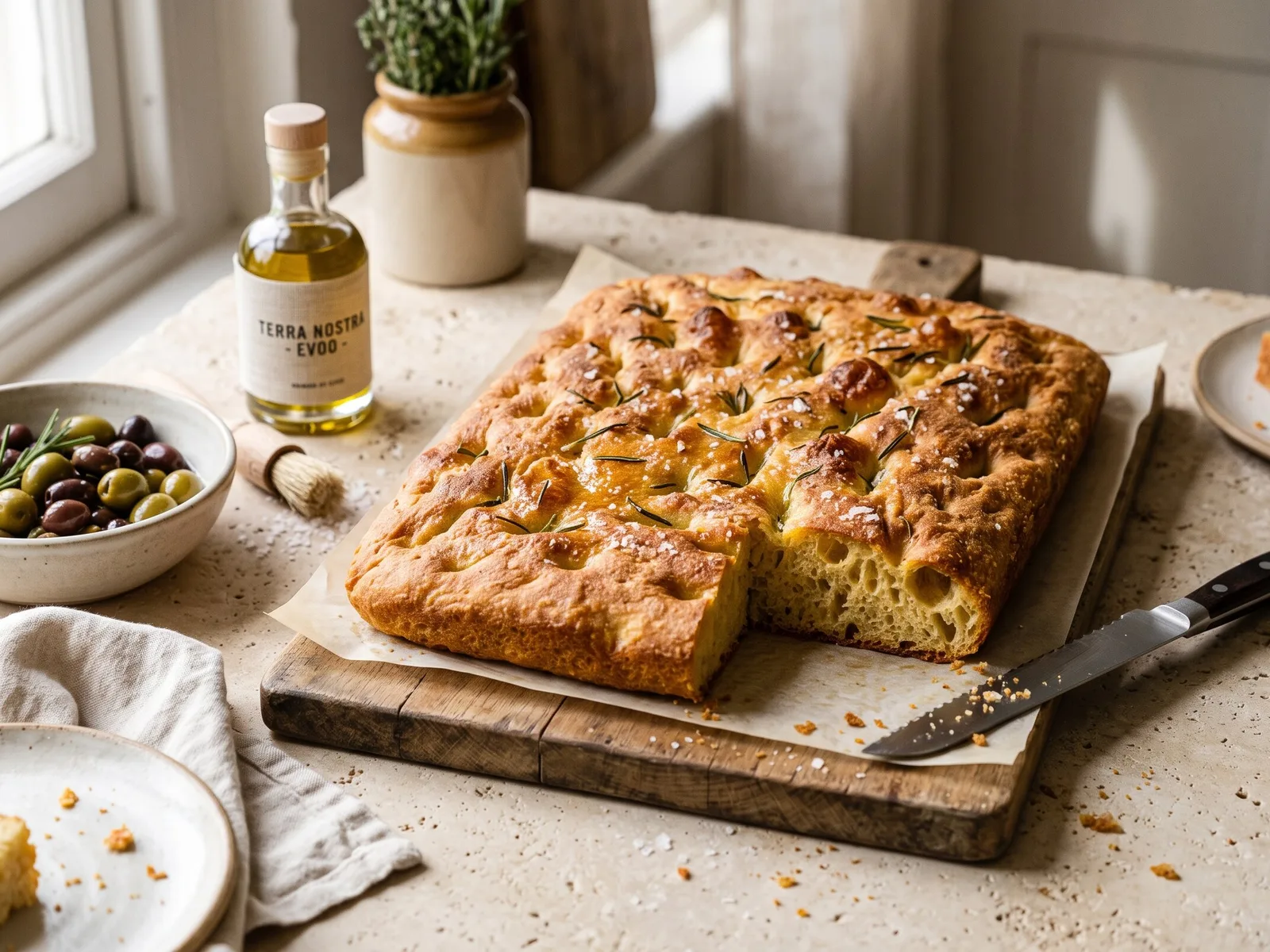
A golden, Puglia-leaning focaccia built on finely-milled durum semolina — nutty and faintly sweet, with a sandy, crisp crust and a warm amber crumb that showcases the flour itself.
- Total
- 5 hr
- Hands-on
- 20 min
- Hydration
- 75%
- Skill
- intermediate
By FocacciaRecipe editorial · Updated 2026-07-11 · In editorial development; independent bake-test pending
The short version
Blend 350 g finely-milled semolina (semola rimacinata) with 150 g soft 00 flour, mix to 75% hydration with 375 g water, 45 g oil, 11 g salt and 5 g yeast, ferment, then dimple and bake at 225°C/435°F for 22–26 minutes. Use rimacinata (re-milled), not coarse semolina, for a tender crumb.
Why this works
Semola rimacinata is durum wheat milled fine enough to build dough, and it carries carotenoid pigments that give the crumb its amber-gold color plus a naturally sweet, nutty flavor. Durum gluten is strong but less extensible than soft-wheat gluten, so blending in soft 00 flour keeps the dough workable and the crumb from turning tight; the fine semolina also lends a faint sandy crispness to the oiled crust that a plain white focaccia does not have.
The schedule
~32m hands-on of 4.8h total · same day
- Mix & fold · 32m
- Bulk ferment · 2.3h
- Proof · 1.3h
- Bake · 24m
- Cool · 20m
Terracotta is active work; olive is unattended rising; red is the bake.
Ingredients
Method
- 1
Mix the semolina dough
Whisk the semola rimacinata, 00 flour and yeast together. Add the water and the 30 g dough oil, then the salt, and mix and knead to a smooth, elastic dough.
Look for: Pale gold and slightly grainy to start, tightening into a satiny, supple dough — a little firmer-feeling than a soft-flour dough.
- 2
Bulk ferment with folds
Do 2–3 stretch-and-folds over the first 90 minutes, then rest until well risen. Durum gluten firms up quickly, so the dough will feel taut but should still be airy.
Look for: Puffed and domed, roughly doubled, with small bubbles under the surface.
- 3
Pan and proof
Oil the pan (dust with a little semolina if you want extra crunch on the base), press the dough out toward the edges, and proof until pillowy.
Look for: Soft and jiggly, filling the pan; a fingertip dent fills back slowly.
- 4
Dimple and season
Oil your fingers and press deep dimples across the dough, then drizzle with the finishing oil and scatter the coarse salt.
Look for: Golden dough holds pools of oil in each dimple; salt crystals sit proud on top.
- 5
Bake
Bake at 225°C/435°F for 22–26 minutes until deep amber-gold with a crisp base.
Look for: Rich golden top, a sandy-crisp crust, and a base that sounds hollow and crisp when tapped.
- 6
Cool
Lift onto a rack and cool at least 20 minutes so the amber crumb sets before cutting.
Look for: The crumb firms to a tender, even amber; the crust stays crisp.
What good looks like
- Crumb: Warm amber-gold, tender but with a gentle durum chew and a nutty, faintly sweet flavor.
- Crust: Sandy, crisp and golden, especially where semolina meets the oiled pan.
- Height: Medium, around 2.5–3 cm.
- Color: Deep amber-gold from the durum pigments.
If something went wrong
| Symptom | Likely cause | Fix |
|---|---|---|
| Tight, tough crumb | All-semolina dough or over-worked durum gluten | Keep the soft-flour portion in the blend and stop kneading once smooth; durum needs less working than soft flour. |
| Gritty, undercooked texture | Coarse semolina used instead of fine rimacinata | Use semola rimacinata (re-milled, flour-fine); coarse semolina will not hydrate into a smooth crumb. |
| Pale, soft base | Too little oil in the pan or oven not fully heated | Oil the pan well, dust with a little semolina, and bake in a fully preheated oven. |
Storing & reheating
Storage: Keeps 1–2 days loosely covered at room temperature; the durum crumb holds moisture well.
Freezing: Freeze cooled pieces wrapped up to 1 month.
Reheating: Refresh in a 200°C/400°F oven for 5–7 minutes to bring back the sandy crust.
Contains wheat/gluten. Naturally vegan as written.
Tools & ingredients for this focaccia
Some links are affiliate links; as an Amazon Associate we may earn from qualifying purchases at no extra cost to you.
Core pantry
- Semolina flour (opens Amazon) ↗ — A pantry staple; fine semola rimacinata is ideal.
- Bread flour (opens Amazon) ↗ — High-protein bread flour or Italian “00” both work.
- Extra-virgin olive oil (opens Amazon) ↗ — Use a good EVOO you like the taste of.
- Fine sea salt (opens Amazon) ↗ — Fine sea salt for the dough.
- Instant yeast (opens Amazon) ↗ — Instant (or active dry) yeast keeps for months.
Fresh — buy local
- Semola rimacinata (opens Amazon) ↗ — A common item; buy fresh or from your pantry.
You don’t need to buy everything here — many items are already in most kitchens. Fresh produce, cheese and herbs are best bought local and in season.
Frequently asked
- What is the difference between semolina and semola rimacinata?
- Semolina is coarse durum meal used for pasta water and dusting; semola rimacinata is that durum re-milled to a fine, flour-like grind that can build a bread dough. This recipe needs the fine rimacinata.
- Why does the crumb look yellow?
- Durum wheat is rich in carotenoid pigments, which give the crumb its natural amber-gold color and part of its sweet, nutty flavor — no additives needed.
Keep baking
In these collections
Source: https://www.focacciarecipe.com/recipes/semolina-focaccia · © 2026 FocacciaRecipe.com
In editorial development — this recipe has not yet completed physical bake-testing.