Unleavened two-sheet cheese-filled focaccia
Recco-Style Cheese Focaccia (Home Adaptation of Focaccia di Recco)
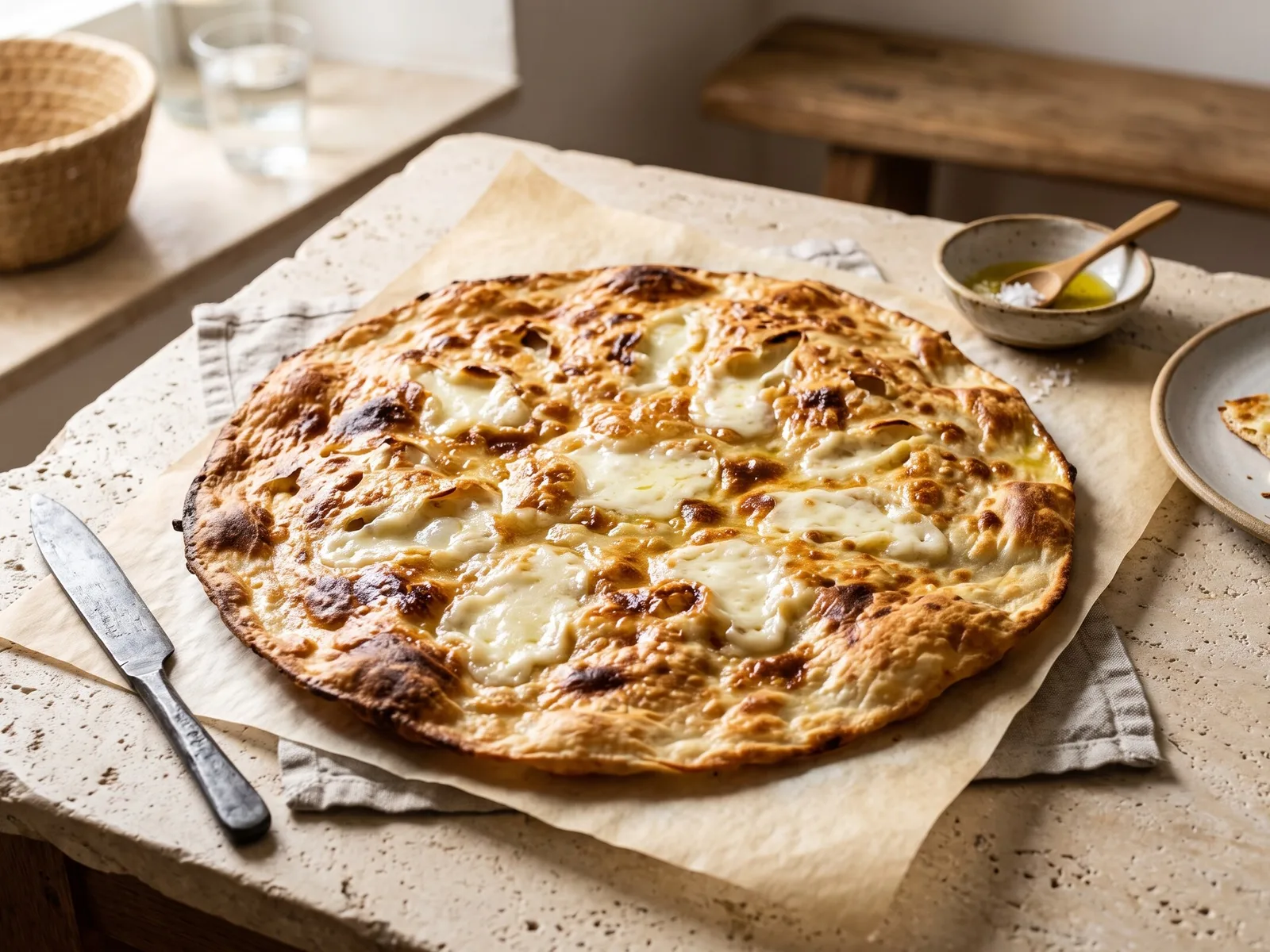
Two wafer-thin, unleavened sheets of dough sealed around molten stracchino, baked blistering hot until the top crackles into golden, cheese-oozing craters — nothing like a fluffy focaccia.
- Total
- 1.8 hr
- Hands-on
- 30 min
- Hydration
- 50%
- Skill
- advanced
By FocacciaRecipe editorial · Updated 2026-07-05 · In editorial development; independent bake-test pending
The short version
Make an unleavened dough (250 g flour, 125 g water, 20 g oil, 4 g salt — no yeast), rest it 30–60 minutes, stretch two paper-thin sheets, dot the bottom sheet with 350 g stracchino/crescenza, cover with the second sheet, seal, tear vents in the top, brush with oil and bake at 250–270°C/480–520°F for 8–12 minutes until blistered and golden.
Why this works
With no leavening the dough can be stretched almost translucent, so it bakes into crisp, shattering layers instead of a soft crumb; a short rest relaxes the gluten enough to pull it that thin; very high heat sets and blisters the thin top before the fresh cheese can weep out, so it stays molten inside.
The schedule
~40m hands-on of 55m total · same day
- Mix & fold · 40m
- Bake · 10m
- Cool · 5m
Terracotta is active work; olive is unattended rising; red is the bake.
Ingredients
Method
- 1
Mix the unleavened dough
Combine flour, water, oil and salt and knead a few minutes to a smooth, firm dough. There is no yeast, so it will not rise.
Look for: Smooth and elastic, firmer than a bread dough and not sticky.
- 2
Rest
Divide into two balls (one slightly larger for the base), oil lightly, cover and rest at room temperature so the gluten relaxes.
Look for: After resting the dough feels softer and pulls without snapping back hard.
Avoid: Skipping the rest makes the dough tear when you try to stretch it thin.
- 3
Stretch the bottom sheet
On a floured cloth or the backs of your hands, roll then hand-stretch the larger ball until almost translucent, wider than your pan. Lay it in an oiled pan with the excess overhanging.
Look for: So thin you can nearly see your hand through it, with the odd tiny hole — that’s fine.
- 4
Fill
Dot lumps of stracchino evenly over the sheet, leaving small gaps and a clear border.
Look for: Little islands of soft cheese scattered across, not a solid layer.
- 5
Cover and seal
Stretch the second ball just as thin, drape it over the top, press the edges to seal, then trim the overhang. Tear or pinch a few vents in the top sheet.
Look for: The two sheets bond at the rim; open tears reveal the cheese below.
- 6
Oil and bake blistering hot
Brush the top with oil, scatter a little flaky salt, and bake at 250–270°C/480–520°F (as hot as your oven runs, ideally on a stone) until blistered and golden.
Look for: The thin top puffs into golden-brown blisters and the cheese bubbles up through the tears.
- 7
Serve at once
Cut into wedges and eat immediately, while the cheese is molten.
Look for: Crisp, shattering top with a river of soft, melted cheese inside.
What good looks like
- Crumb: None in the usual sense — thin crisp pastry-like layers, not an airy crumb.
- Crust: Blistered, brittle, golden top and base.
- Height: Very thin and flat — just two sheets around the cheese.
- Color: Patchy golden-brown blisters over a pale field.
If something went wrong
| Symptom | Likely cause | Fix |
|---|---|---|
| Dough tears while stretching | Not rested enough, or flour too strong | Rest longer and use soft 00 flour; patch small holes as you go. |
| Cheese leaks out and burns | Poor edge seal or too much filling | Press the rim firmly, keep a clear border, and don’t overfill. |
| Pale, soft, not blistered | Oven not hot enough | Bake as hot as the oven allows, ideally on a preheated stone or steel. |
Storing & reheating
Storage: Meant to be eaten straight from the oven; it does not keep or reheat well.
Reheating: Not recommended — the thin crust goes leathery. Bake and serve fresh.
Contains wheat/gluten and dairy.
Tools & ingredients for this focaccia
Some links are affiliate links; as an Amazon Associate we may earn from qualifying purchases at no extra cost to you.
Core pantry
- Bread flour (opens Amazon) ↗ — High-protein bread flour or Italian “00” both work.
- Extra-virgin olive oil (opens Amazon) ↗ — Use a good EVOO you like the taste of.
- Fine sea salt (opens Amazon) ↗ — Fine sea salt for the dough.
- Flaky finishing salt (opens Amazon) ↗ — For the crunchy finish.
Fresh — buy local
- Cheese (opens Amazon) ↗ — Buy fresh from a good cheese counter or deli.
You don’t need to buy everything here — many items are already in most kitchens. Fresh produce, cheese and herbs are best bought local and in season.
Frequently asked
- Is this the real focaccia di Recco?
- No — it’s a home adaptation. The genuine Focaccia di Recco col Formaggio is a registered IGP tied to the town of Recco and a strictly defined method; this version reproduces the technique at home.
- Why is there no yeast?
- By design. Focaccia di Recco is unleavened so the dough can be stretched paper-thin and bake into crisp, blistered layers rather than a soft, risen crumb.
Keep baking
In these collections
Source: https://www.focacciarecipe.com/recipes/recco-style-cheese-focaccia · © 2026 FocacciaRecipe.com
In editorial development — this recipe has not yet completed physical bake-testing.